
How the 3-Year Spouse Rule Can Fast-Track Your Path to US Citizenship
Feldman Feldman & Associates PC is based in San Diego and represents clients nationwide.
Key Takeaways: If you are a lawful permanent resident married to a U.S. citizen, you may apply for naturalization after just 3 years of continuous residence instead of the standard 5 years under INA §319(a). You must demonstrate marital union with your citizen spouse for the entire 3-year period, meet physical presence and state residency requirements, and satisfy English, civics, and good moral character standards. You can file Form N-400 up to 90 days before completing your 3-year requirement. Absences exceeding 6 months may disrupt eligibility, so strategic timing matters. An experienced immigration attorney can coordinate your N-400 filing with any pending I-751 petition to protect your status.
The 3-year spouse rule is one of the most significant advantages in U.S. immigration law for green card holders married to American citizens. Under INA §319(a), codified at 8 USC §1430(a), a lawful permanent resident living in marital union with a U.S. citizen spouse may file for naturalization after only 3 years of continuous residence, cutting two years off the standard 5-year timeline under INA §316(a). Understanding whether you qualify, what documentation you need, and when to file are critical first steps.
We’re an award-winning law firm in San Diego, California, with 50+ years of experience in immigration law. Talk to an immigration attorney at Feldman Feldman & Associates PC by calling 1-619-299-9600 today.
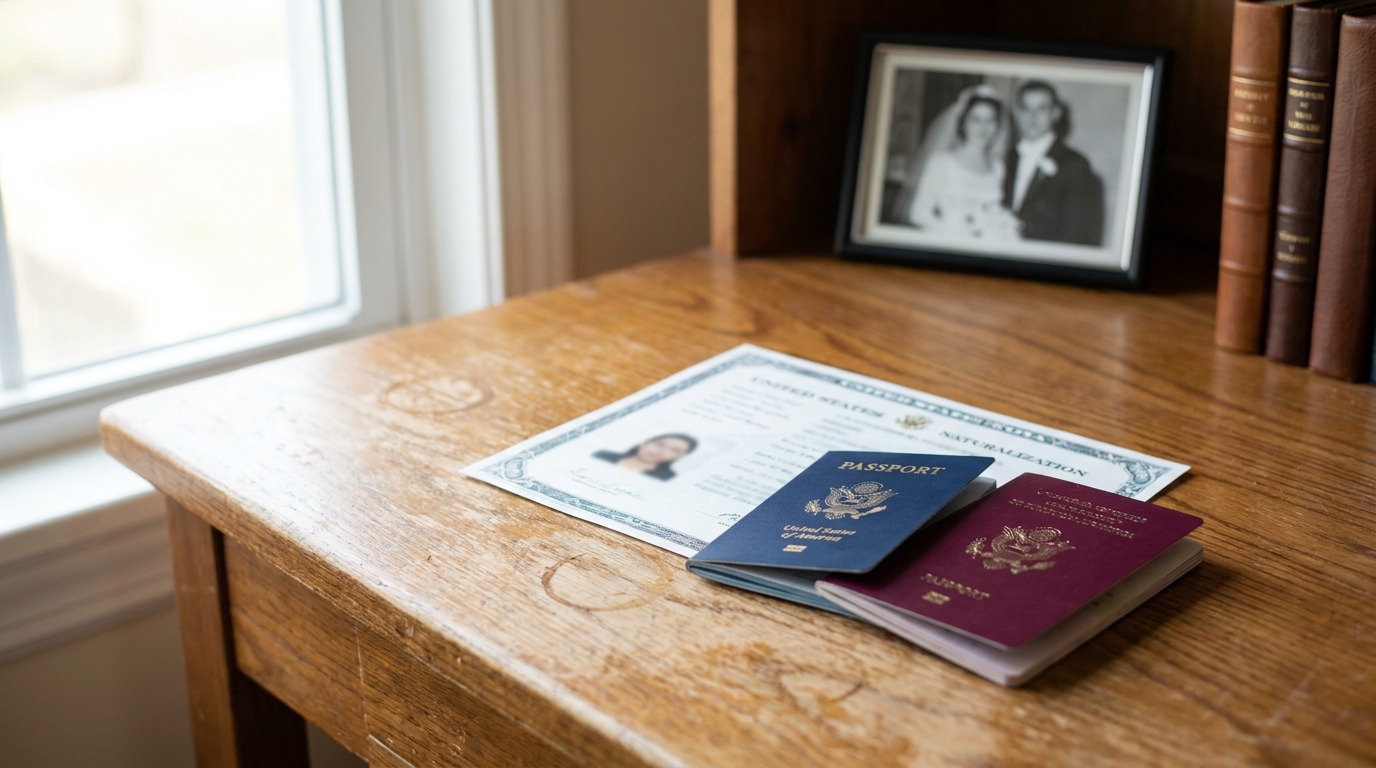
US Citizenship Requirements Under the 3-Year Spouse Rule
To qualify for naturalization under the 3-year rule, you must satisfy every statutory element in 8 USC §1430(a). You must have been a lawful permanent resident for at least 3 years immediately before filing Form N-400 and living in marital union with your U.S. citizen spouse during that entire 3-year period immediately before filing; the statute itself does not require the marital union to continue through adjudication. Your citizen spouse must have held U.S. citizenship for the full 3-year period preceding your application.
Beyond marriage and residency requirements, applicants must meet the same foundational standards that apply to all naturalization cases. You must read, write, and speak English and demonstrate knowledge of U.S. history and government. You must also establish good moral character for the statutory period. These requirements are not waived under the shorter timeline.
💡 Pro Tip: Start gathering marital evidence early. Joint tax returns, shared lease agreements, bank statements, and insurance policies demonstrate genuine marital union. Documentary consistency between your N-400 and any prior I-751 filing is critical.
Physical Presence and State Residency
You must have been physically present in the United States for at least 18 months out of the 3 years immediately before filing. This is proportional to the 30-months-out-of-5-years requirement for standard applicants under INA §316(a) / 8 USC §1427(a). You must also have resided in the state or USCIS district where you file for at least 3 months before submitting Form N-400.
Travel outside the United States requires careful tracking. According to the USCIS Policy Manual, an absence exceeding 6 months but less than 1 year is presumed to break residence continuity. You may overcome this presumption with evidence, but the burden falls on you. An absence of 1 year or more generally breaks continuous residence entirely.
| Requirement | 3-Year Spouse Rule (INA §319(a)) | Standard Rule (INA §316(a)) |
|---|---|---|
| Continuous Residence | 3 years | 5 years |
| Physical Presence | 18 months | 30 months |
| State/District Residency | 3 months | 3 months |
| Marital Union with Citizen Spouse | Required for full 3 years | Not applicable |
| English & Civics Test | Yes | Yes |
| Good Moral Character | Yes (3-year period) | Yes (5-year period) |
💡 Pro Tip: Keep a detailed log of every trip outside the United States, including exact departure and return dates. Even short trips add up, and falling below 18 months physical presence can result in denial.
Filing Form N-400: Strategic Timing and Early Filing
You don’t have to wait until completing exactly 3 years of continuous residence to file. USCIS allows spouse-based applicants to submit Form N-400 up to 90 days before meeting the 3-year requirement. For example, if your 3-year mark falls on September 1, 2026, you could file as early as June 3, 2026. This early filing window significantly shortens your overall citizenship timeline.
Timing is especially important if you have a pending I-751 petition to remove conditions. If your marriage was less than two years old when your green card was approved, you received conditional permanent residence and must file Form I-751 within 90 days before your card expires. A pending I-751 doesn’t automatically bar N-400 filing, but coordinating both requires careful strategy. Learn more in our guide on whether conditional residents can apply for naturalization early.
💡 Pro Tip: If both applications are pending, USCIS may schedule a combined interview. Ensure evidence submitted in both applications tells a consistent story about your marriage and residence history.
What Happens if Your Marriage Ends Before Adjudication?
The statute’s marital union requirement applies to the three years immediately preceding the date of filing the N-400. However, 8 CFR §319.1(b)(2)(i) provides that a divorce occurring at any point before the applicant’s admission to citizenship will disqualify the applicant from eligibility under the 3-year rule; separately, 8 CFR §319.1(b)(2)(ii)(A) provides that a legal separation will break the continuity of the marital union required for eligibility. These regulatory requirements go beyond what INA §319(a) explicitly states, as the statute itself only requires living in marital union during the 3 years preceding the date of filing and does not explicitly require marital union to continue through adjudication.
An important exception exists for domestic violence survivors. Under 8 USC §1430(a), applicants battered or subjected to extreme cruelty by a U.S. citizen spouse or parent may be exempt from the requirement that marital union be intact at adjudication. This protection ensures victims aren’t forced to remain in dangerous situations to preserve their citizenship path.
Special Rules for Spouses of US Citizens Employed Abroad
INA §319(b) covers spouses of U.S. citizens stationed overseas for qualifying employment. If your citizen spouse works for the U.S. government (including military), certain American firms, qualifying religious organizations, or certain international organizations and is scheduled to be stationed abroad for at least one year, you may naturalize without meeting continuous residence or physical presence requirements. Under 8 USC §1430(b), you must be lawfully admitted for permanent residence and physically present in the United States at naturalization.
This provision ensures military families and government employees aren’t penalized for serving abroad. However, you must still meet all other requirements, including English proficiency, civics knowledge, and good moral character. Eligibility under §319(b) is fact-specific, and documentation of your spouse’s qualifying employment is essential.
💡 Pro Tip: If your spouse’s overseas assignment is upcoming, consult an immigration attorney before departure. Filing strategy differs significantly when §319(b) applies versus the standard §319(a) path.
How to Prove You Meet the US Citizenship Requirements
Demonstrating Continuous Residence
USCIS reviews all relevant records to verify continuous residence. The agency examines travel history, tax returns, employment records, and lease or mortgage documents. Applicant testimony is considered but must align with documentary evidence. Gaps or inconsistencies may trigger a Request for Evidence (RFE) or denial.
Establishing Good Moral Character
Good moral character is required for the entire 3-year period before filing. USCIS examines criminal history, tax compliance, child support obligations, and prior immigration violations. Certain criminal convictions can create permanent or temporary bars. If you have concerns about your background, address them before filing rather than at your interview.
💡 Pro Tip: Order your own FBI background check before filing Form N-400. Knowing what USCIS will see allows you and your attorney to prepare explanations or gather mitigating evidence in advance.
English and Civics Testing
At your naturalization interview, a USCIS officer tests your ability to read, write, and speak English and asks questions about U.S. history and government. The English component is evaluated during your interview through conversation, reading, and writing exercises. Certain age and residence-based exemptions exist, but most citizenship through marriage applicants under the 3-year rule must pass both tests. Civics test preparation is straightforward: USCIS publishes a full list of 128 possible civics questions for applicants who filed Form N-400 on or after October 20, 2025; applicants who filed before that date use the older 100-question pool.
Frequently Asked Questions
1. Can I apply for citizenship after 3 years if my spouse became a citizen recently?
No. Under 8 USC §1430(a), your U.S. citizen spouse must have held citizenship for the entire 3-year period immediately preceding your N-400 filing. If your spouse naturalized partway through that window, you may need to wait until 3 full years have passed since their naturalization or file under the standard 5-year rule.
2. Does a pending I-751 prevent me from filing Form N-400?
Not necessarily. A pending I-751 doesn’t automatically bar naturalization filing. However, USCIS must be satisfied you are a lawful permanent resident at adjudication. Coordinating these filings requires attention to documentation and timing.
3. What if I traveled abroad for more than 6 months during the 3-year period?
An absence exceeding 6 months but less than 1 year creates a rebuttable presumption that continuous residence was broken. Overcome this by submitting evidence of U.S. ties, such as continued employment, an active lease, and family presence. An absence of 1 year or more generally breaks continuity entirely.
4. Can I file N-400 before I complete exactly 3 years of permanent residence?
Yes. USCIS permits spouse-based applicants to file up to 90 days before satisfying the 3-year continuous residence requirement. However, you must meet all other eligibility requirements at your interview and oath ceremony.
5. What is the difference between INA §319(a) and §319(b)?
INA §319(a) is the standard 3-year spouse rule requiring continuous residence and physical presence in the United States. INA §319(b) applies to spouses of U.S. citizens employed abroad by qualifying employers and waives residence and physical presence requirements. Both require lawful permanent resident status, good moral character, and passage of English and civics exams.
Take the Next Step Toward Citizenship
If you are a green card holder married to a U.S. citizen, the 3-year spouse rule under INA §319(a) may allow you to become a citizen sooner than you think. The requirements are specific, and the stakes are high. From proving continuous residence and physical presence to coordinating a pending I-751 with your N-400, every detail matters. Filing errors, missed deadlines, or inconsistent documentation can delay your case or put your status at risk. Working with an immigration attorney experienced in naturalization matters helps you avoid common pitfalls and move forward with confidence.
¿Tiene preguntas sobre la ciudadanía? Nuestro equipo también atiende en español.
Contact Feldman Feldman & Associates PC to discuss your naturalization eligibility and filing strategy. Call 1-619-299-9600 or reach out to schedule a consultation today.