
Filing I-130 and I-485 Together for a Marriage-Based Green Card in California
Key Takeaways: U.S. citizens can file Form I-130 and Form I-485 concurrently for a spouse in the United States because spouses are immediate relatives with no visa limits. Concurrent filing in 2026 allows your spouse to apply for work and travel authorization while the case is pending. Lawful entry is generally required for adjustment of status, though immediate relatives who entered lawfully but fell out of status may still be eligible. The filing fee for Form I-130 is $675 by paper or $625 online, and $1,440 for Form I-485. Couples in California typically interview at their local USCIS field office. Working with an experienced immigration attorney helps avoid errors that delay approval or trigger removal proceedings.
Feldman Feldman & Associates PC is based in San Diego and represents clients nationwide.
If you are a U.S. citizen married to a foreign national living in the United States, you may be able to file the I-130 immigrant petition and I-485 adjustment of status application simultaneously. This process, known as concurrent filing, is one of the fastest paths to a marriage-based green card in 2026. Because spouses of U.S. citizens are immediate relatives with no annual visa cap, a visa number is always immediately available, making concurrent filing possible without waiting.
We’re an award-winning law firm in San Diego, California, with 50+ years of experience in immigration law. Talk to an immigration attorney at Feldman Feldman & Associates PC by calling 1-619-299-9600 today.
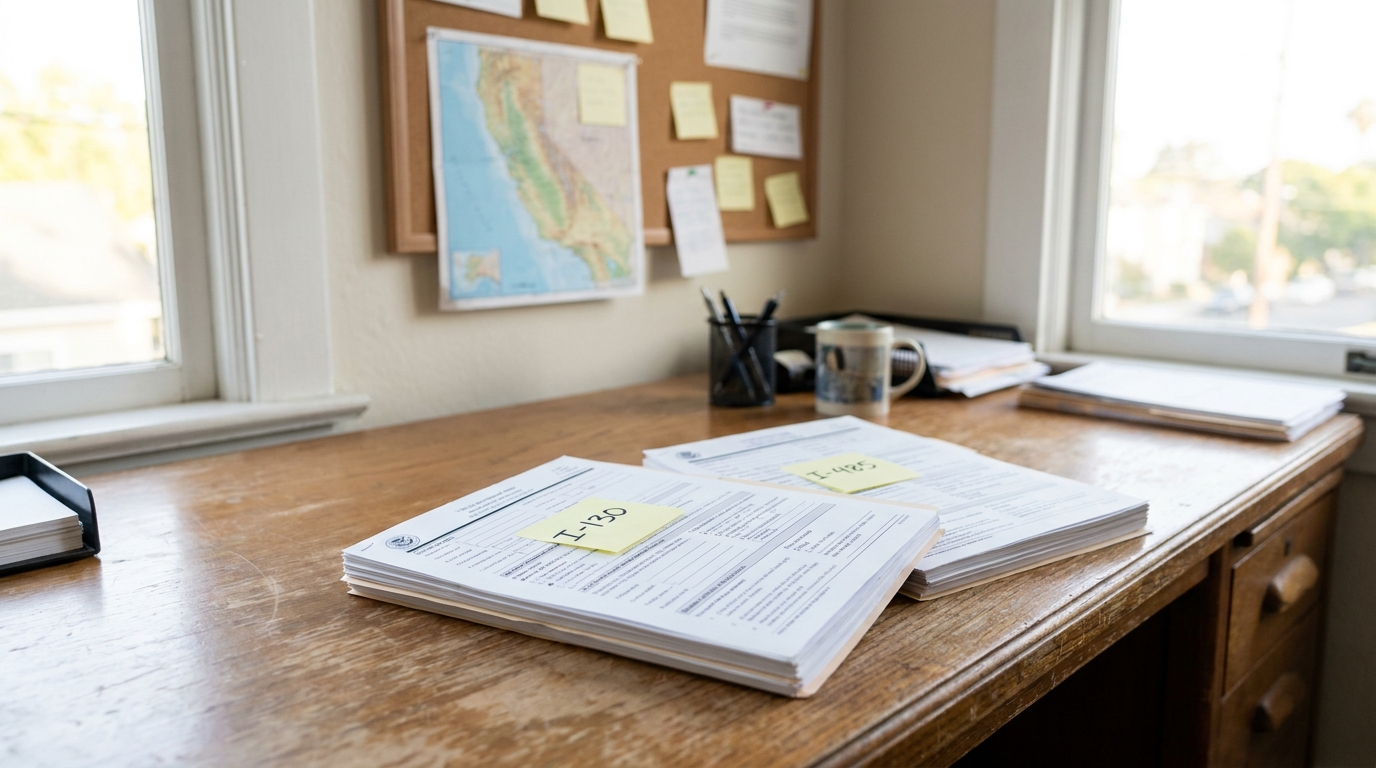
What Is Concurrent Filing and Why Does It Matter for Marriage Green Card Cases?
Concurrent filing allows a U.S. citizen petitioner to submit Form I-130 and the beneficiary spouse to submit Form I-485 in the same package to USCIS. Without concurrent filing, the petitioner would first file the I-130, wait for approval, and only then could the spouse apply for a green card. For immediate relatives of U.S. citizens, spouses, parents, and unmarried children under 21, there is no limit on available green cards, making concurrent filing always an option when the spouse is in the U.S. and eligible.
The practical benefit is significant: your spouse gains access to interim benefits while USCIS processes the case. While the I-485 is pending, your spouse can apply for employment authorization using Form I-765 and advance parole travel authorization using Form I-131. These interim documents allow your spouse to work legally and travel internationally without abandoning the application. Many California couples rely on these benefits because processing times often exceed a year.
💡 Pro Tip: File Form I-765 and Form I-131 with your I-130 and I-485 package. Submitting everything together reduces delays and ensures faster work and travel authorization.
Eligibility Requirements for the Spousal Green Card Process in California
Lawful Entry and Immigration Status
Adjustment of status generally requires that the applicant entered the United States lawfully, meaning they were inspected and admitted or paroled by an immigration officer. This means your spouse was admitted by a U.S. Customs and Border Protection officer, typically with a valid visa or travel document. There is an important exception for immediate relatives of U.S. citizens: a spouse who entered lawfully but whose authorized stay expired or who fell out of status may still be eligible to adjust. However, if your spouse entered without inspection, adjustment is generally unavailable, and consular processing abroad may be required.
Proving a Bona Fide Marriage
USCIS requires couples to demonstrate their marriage is genuine and was not entered into for immigration purposes. Prepare credible evidence such as joint lease agreements, shared bank statements, joint insurance policies, photographs together over time, and affidavits from people who know you as a married couple. USCIS adjudicators are trained to identify inconsistencies. An attorney familiar with USCIS adjudication trends can help you organize and present evidence effectively.
💡 Pro Tip: Start gathering marriage evidence well before filing. Consistent documentation over time, such as monthly bank statements and utility bills in both names, is more persuasive than evidence created shortly before filing.
Where to File and What to Expect in California
Your I-130 and I-485 package is mailed to either the USCIS Chicago or Phoenix Lockbox, depending on where you live. California residents filing concurrently generally send their package to the Phoenix Lockbox. USCIS will issue receipt notices for each form, and biometrics appointments are scheduled at an Application Support Center near your home. The adjustment of status interview is then scheduled at your local USCIS field office.
For couples in San Diego, the interview typically occurs at the USCIS San Diego field office. Both the U.S. citizen petitioner and beneficiary spouse must attend together. The officer will review your petition, ask questions about your relationship, and examine supporting documents. Being well-prepared for this interview is critical to smooth approval.
| Step | Form | Where Filed | Fee (2026) |
|---|---|---|---|
| Immigrant Petition | I-130 | USCIS Lockbox (Phoenix for CA) | $675 (paper) / $625 (online) |
| Adjustment of Status | I-485 | Filed concurrently with I-130 | $1,440 (paper) / $1,375 (online) |
| Work Authorization | I-765 | Filed concurrently with I-485 | Separate fee applies |
| Travel Authorization | I-131 | Filed concurrently with I-485 | Separate fee applies |
💡 Pro Tip: Make copies of your entire filing package before mailing. If USCIS loses documents or issues a Request for Evidence, having duplicates will save significant time and stress.
When Concurrent Filing May Not Be the Right Strategy
Concurrent filing is not advisable in every situation, and filing when ineligible can have severe consequences. If the immigrating spouse entered unlawfully, has prior immigration violations, or has criminal history that could trigger inadmissibility, submitting an I-485 could bring that person to USCIS’s attention and potentially result in removal proceedings. A denied adjustment application can lead to a Notice to Appear in immigration court.
Couples should exercise caution when the marital relationship is difficult to document. If you married recently with limited joint evidence, or if there are significant age or language gaps USCIS may scrutinize, it may be strategically better to file the I-130 first, obtain approval, and then pursue adjustment from a stronger position. An experienced marriage-based green card attorney in San Diego can evaluate your circumstances and recommend the safest approach.
Conditional Green Cards and the I-751 Filing Requirement
What Is Conditional Permanent Residence?
If your marriage is less than two years old when USCIS approves the green card, your spouse will receive conditional permanent residence valid for two years, not ten. This is standard under the Immigration and Nationality Act (INA § 216) and is not a negative finding. Congress created this step to verify the marriage remains genuine.
The 90-Day I-751 Filing Window
Your spouse must file Form I-751, Petition to Remove Conditions on Residence, within the 90-day window before the conditional green card expires. Missing this deadline can result in loss of status and potential removal proceedings. The I-751 requires updated evidence that the marriage is ongoing and bona fide, including recent joint financial documents, tax returns, and evidence of shared life together.
💡 Pro Tip: Set a reminder for 120 days before your spouse’s conditional green card expires. This gives you a 30-day cushion to gather documents before the 90-day window opens.
USCIS Processing Times and What They Mean for Your Case
Processing times for I-130 and I-485 vary by USCIS service center and field office, and change monthly. Check current estimates on the USCIS processing times page. In 2026, many marriage-based concurrent filings (I-130 and I-485 filed together) for spouses of U.S. citizens take approximately 8 to 17 months from filing to final green card approval, though this varies by USCIS service center and field office. The San Diego field office handles high volume, and scheduling delays can occur.
Filing a complete and accurate package from the start is the most effective way to avoid Requests for Evidence that add months to your timeline. Respond promptly to biometrics or interview notices to keep your case on track.
💡 Pro Tip: Create a shared folder (digital and physical) where you store every USCIS receipt notice, appointment letter, and correspondence. Staying organized makes it easier to respond quickly if USCIS requests additional information.
Frequently Asked Questions
1. Can I file I-130 and I-485 together if my spouse overstayed a visa?
In many cases, yes. Spouses of U.S. citizens are immediate relatives, and immediate relatives are generally exempt from adjustment bars that apply to individuals who failed to maintain status or worked without authorization, provided they were inspected and admitted or paroled into the United States. However, this exception does not apply to individuals who entered without inspection. Consulting an immigration attorney is strongly recommended.
2. How long does the concurrent filing process take in California in 2026?
Processing times vary by service center and field office. As of 2026, many marriage-based concurrent filings (I-130 and I-485 filed together) for spouses of U.S. citizens take approximately 8 to 17 months from filing to final green card approval. Check current estimates on the USCIS processing times website.
3. Can my spouse work while the I-485 is pending?
Yes. While the I-485 is pending, your spouse is eligible to apply for employment authorization using Form I-765. Once approved, this permits lawful employment. Your spouse may also apply for travel authorization using Form I-131 to travel internationally without abandoning the application. For I-485 applications filed on or after April 1, 2024, separate filing fees apply for Form I-765 and Form I-131.
4. Do I need to file a separate I-130 for each family member?
Yes. A separate I-130 form must be filed for each eligible relative. You cannot include multiple beneficiaries on a single petition. Each petition requires its own filing fee of $675 by paper or $625 online.
5. What happens if our concurrent filing is denied?
A denied I-485 can have serious consequences. If the denial is based on inadmissibility or fraud concerns, USCIS may issue a Notice to Appear in immigration court, initiating removal proceedings. This is why evaluating eligibility carefully before filing and ensuring thorough preparation is critical.
Take the Next Step Toward Your Marriage-Based Green Card
Filing I-130 and I-485 concurrently is one of the most efficient ways for U.S. citizens to obtain a green card for a spouse already living in the United States. The process requires careful preparation, complete documentation, and clear understanding of eligibility rules, particularly regarding lawful entry and admissibility. For California couples, getting the filing right the first time can mean the difference between smooth approval and months of delays or removal proceedings.
Feldman Feldman & Associates PC has more than 50 years of experience guiding couples through the marriage-based green card process. If you are ready to file or have questions about eligibility, contact our immigration team today or call 1-619-299-9600 to schedule a consultation.
También ofrecemos servicios en español. Llámenos hoy para una consulta.